Columbia River Links

Columbia Basin News

USACE delivers materials, offers on-the-ground expertise to numerous threatened communities for flood-damaged levees
12/17/2025 UPDATED
Army Corps Emergency Management team continues its flood fight support, providing critical flood-fighting materials and on-the-ground expertise to local and county partners across western Washington,...
Public crossing at Little Goose Dam closed Dec. 15 - 24
12/9/2025 UPDATED
STARBUCK, Wash. – Public crossing at the U.S. Army Corps of Engineers’ Little Goose Lock and Dam will be closed from Dec. 15 - 24 for maintenance...
Water conservation measures at Chittenden Locks may cause delays for recreational boaters
7/15/2025 UPDATED
U.S. Army Corps of Engineers officials anticipate Lake Washington’s level could drop below 20 feet this summer for the first time since October 1987 and are taking proactive steps to conserve water...

Columbia River Basin

A barge transits down a river(Above) A barge makes its way down the Columbia River.

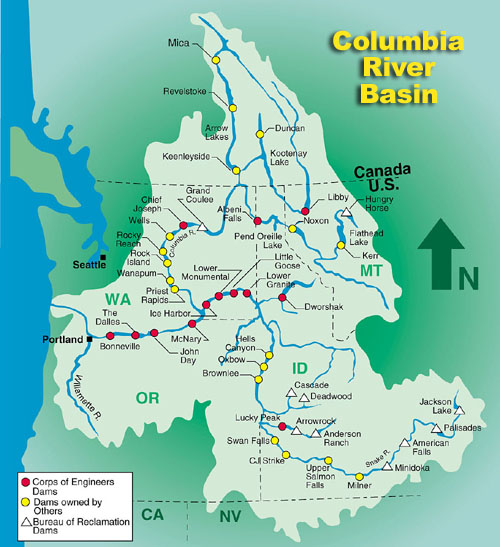
The Columbia River Basin is a large and complex system with variable stream flows and weather patterns. Fourteen federal projects (dams) in Idaho, Montana, Oregon and Washington make up the system. The economic vitality of the region and its Tribes, communities, industries, and fish and wildlife species all depend on the system's ability to provide for multiple uses, including flood risk management, hydropower generation, navigation, irrigation, recreation, water quality, and fish and wildlife. The U.S. Army Corps of Engineers is committed to managing the Columbia River System in a responsible way in accordance with the Congressional authorized purposes of the projects.


Environmental Compliance

The U.S. Army Corps of Engineers and the Bureau of Reclamation, or co-lead agencies, issued a notice of intent in the Federal Register on December 18, 2024 that announced the intent to collect public comments.

The co-lead agencies intend to supplement the 2020 Columbia River System Operation (CRSO) Final Environmental Impact Statement (EIS), including the selected alternative, to address new information and circumstances since it was published in 2020. The 2020 CRSO EIS analyzed the coordinated operation and maintenance of fourteen Federal multi-purpose dams and related facilities located throughout the Columbia River Basin. As part of scoping, the co-lead agencies will seek input from the public to inform an SEIS as they recognize the need for additional collaborative dialogue about the system.

The co-lead agencies made the decision to supplement the 2020 CRSO EIS after a review process that considered available facts and input from Tribal partners, stakeholders, and federal and state agencies in fall 2024. After this review, the co-lead agencies determined initiating a SEIS was appropriate to evaluate the updated and changed circumstances that include, but are not limited to:

  • Changes to operations, maintenance, and configuration of the fourteen projects that make up the Columbia River System.
  • New species that have been listed or proposed for listing under the ESA (e.g., Wolverine).
  • Relevant new reports, studies, or other information published since the CRSO EIS was completed.

In the interim, the co-lead agencies will continue to operate the Columbia River System to meet its congressionally authorized purposes, including flood risk management, water supply, navigation, hydropower generation, recreation, and fish and wildlife. 

UPDATE as of May 1, 2025. View the news announcement.

The co-lead agencies, are extending the public comment period for the Columbia River System Operations Supplemental Environmental Impact Statement (SEIS) to August 15, 2025.

USACE and Reclamation are committed to transparency and meaningful public engagement, and both agencies remain available to discuss the SEIS and provide information related to this process. The co-lead agencies’ goal is to ensure the use of updated information to continue balancing the Columbia River System’s authorized purposes in accordance with all relevant laws and regulations and to continue operating and maintaining their facilities to meet Congressionally authorized purposes.

The co-lead agencies continue to seek public input and invite federal and state agencies, Native American Tribes, local governments, and the public to submit comments relevant to the supplemental NEPA process. The agencies will also publish the end date of the comment period in the Federal Register and will post an updated schedule for the public scoping meetings on the project website.

Phase II Implementation Plan

The Phase II Implementation Plan (P2IP) is a 20 year, $300M plan developed by the Upper Columbia Unified Tribes (UCUT) to conduct studies to inform the feasibility of salmon reintroduction above Chief Joseph and Grand Coulee Dams on the Columbia River. In 2023, the Bonneville Power Administration, Bureau of Reclamation, and the U.S. Army Corps of Engineers (USACE) agreed to provide funding and technical support for the P2IP. 

Once the UCUT complete the study, there would be a recommendation on implementation, which would require additional funding. This would be phase three, in approximately 2042. USACE has signed a Finding of no Significant Impact (FONSI) as part of the National Environmental Policy Act compliance process for the P2IP, April 21, 2025. It is available here: https://usace.contentdm.oclc.org/utils/getfile/collection/p16021coll7/id/27780. The FONSI documents that there would be no significant adverse effects on the quality of the environment from implementation of the P2IP.   Bonneville Power Administration and the Bureau of Reclamation participated as co-leads on the NEPA process.